

“My experiences in 2020 changed my life. Writing helped me process them. Sharing them has helped me connect with other men. And now I want to keep using that experience to help other people break the silence that I once struggled to break myself.”
A Global Pandemic
For a long time, I didn’t really understand what emotional silence looked like.
I thought I was just getting on with life.
Like a lot of men, I had learned to keep things moving, get on with things and deal with whatever was in front of me.
Until 2020 happened.
For me, 2020 wasn’t just lockdowns, masks and restrictions.
It nearly cost me my life.
It started with a cough that resulted in a snapped rib, pneumonia and fluid being drained from my lung.
Then, a few months later, completely unexpectedly, I suffered a brain haemorrhage.
A bleed on the brain.
And all of this happened in the middle of a global pandemic.
I was isolated in hospital, unable to have family around me, surrounded by machines, masked faces and an awful lot of time alone with my thoughts.
When you suddenly realise that your own body can let you down without warning, it changes the way you see life.
But it also changes the way you see yourself.
I remember asking myself:
“Who am I now?”
Who was I before all of this?
Who did people expect me to be?
And who was I supposed to become after it?
I found myself in a place where I was physically recovering, but mentally I was trying to work out who I was again.
I wasn’t suicidal.
I wasn’t completely out of control.
I was just overwhelmed, disconnected and quietly exhausted.
And I think that’s something a lot of men can relate to.
Because emotional struggles don’t always look dramatic.
Sometimes they look like going to work.
Going to the gym.
Having a laugh with your mates.
Posting on social media.
Saying:
“I’m alright.”
And then going home and sitting alone with everything you haven’t said.
For me, writing became the way I started to break that silence.
I didn’t start writing because I wanted to become an author.
I wrote because I needed somewhere to put everything I was feeling.
The fear.
The anger.
The confusion.
The questions.
The things I couldn’t say out loud.
Eventually, that writing became my book:
2020: The Year That Tried To Kill Me

Writing didn’t magically fix everything.
But it gave my thoughts somewhere to go.
And somewhere along that journey I realised something:
My story wasn’t just something I had survived. It could potentially help someone else feel less alone.
That changed everything.
Because I’ve come to believe that sometimes the most powerful thing you can give another person isn’t advice.
It’s the courage to say:
“I’ve been there too.”
That’s a big part of why I’ve become involved with men’s mental health and men’s groups.
I’ve been a member of Men’s Walking and Talking, where I’ve seen first-hand what can happen when men are given a safe space to walk, talk and simply be themselves.

The ‘Men Walking And Talking’ Group I attend
I’ve also been involved with Oswestry Men’s Mental Health Club, another place where men can come together, talk openly and realise they aren’t the only ones carrying things they don’t always know how to talk about.
I’ve had the opportunity to share my own story with these groups too.
And every time I stand up and talk about what happened to me, there’s always a little voice in my head asking:
“Are you really going to tell them that?“
And then I remember why I’m doing it.
Because if I can stand in a room and say:
“This happened to me. I struggled. I didn’t have all the answers. And I’m still here.”
Maybe someone else will feel like they can say:
“This is happening to me too.”
That’s what breaking emotional silence means to me.
It doesn’t mean forcing men to talk.
It doesn’t mean making everyone share their deepest feelings.
And it certainly doesn’t mean pretending that opening up is easy.
It means creating spaces where men know they can talk when they’re ready.
Where vulnerability isn’t seen as weakness.
Where asking for help isn’t failure.
Where saying “I’m struggling” isn’t something to be ashamed of.
Because I’ve learned that real strength isn’t about pretending you’re okay.
Real strength is being honest enough to admit when you’re not.
My experiences in 2020 changed my life.
Writing helped me process them.
Sharing them has helped me connect with other men.
And now I want to keep using that experience to help other people break the silence that I once struggled to break myself.
I don’t have a psychology degree.
I’m not a guru.
I haven’t figured everything out.
I’m simply a man who went through something that changed him, found a way to make sense of it, and decided that if sharing my story could help another man feel less alone, then it was worth telling.
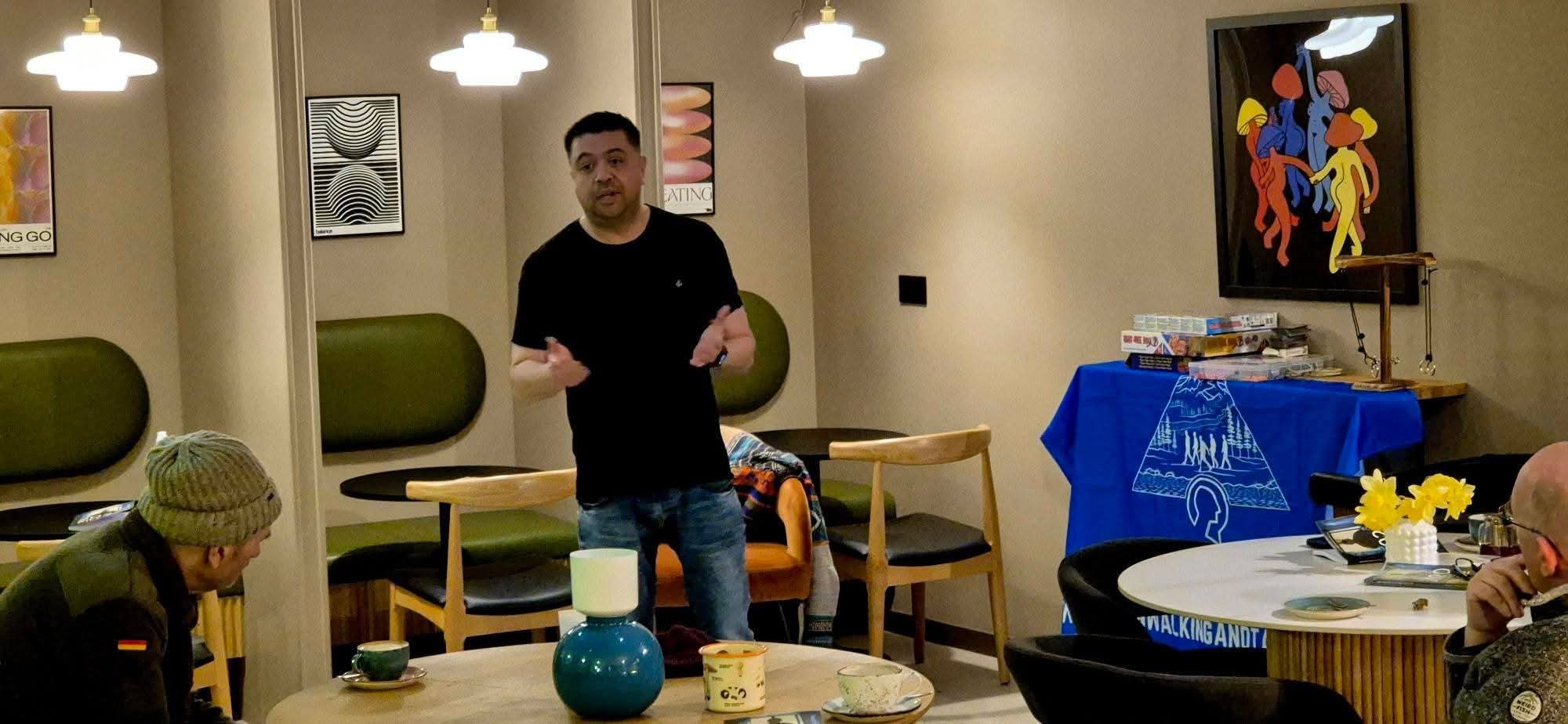
Me talking at one of the group sessions
So if you’re reading this and you’re carrying something quietly…
You don’t have to tell everyone.
You don’t have to have the right words.
You don’t even have to be ready yet.
But please don’t convince yourself that you have to carry it all on your own.
Don’t hide.
Your story matters.
Your voice matters.
And sometimes, simply saying “I’m not alright” can be the beginning of something changing.
If my story can help one man feel able to open up, then everything I’ve been through has a purpose.